For years coaching youth baseball and softball, I've noticed something almost every new coach experiences.
A player doesn't do what the coach expects, and the coach assumes the player just wasn't paying attention.
But most of the time, that is not actually what is happening.
The reality is young players often do not yet understand why certain baseball and softball situations should be handled a specific way. And honestly, that makes perfect sense.
As coaches, we have watched thousands of plays over our lifetime. We instinctively recognize weak arms, bad angles, slow transfers, force situations, momentum shifts, and defensive mistakes before they fully happen. A 7-, 8-, or 9-year-old usually sees one thing at a time.
That gap between what the coach sees and what the player sees is where a lot of youth baseball and softball frustration happens. Over time, I've learned that one of the most important parts of coaching is not only teaching mechanics. It is teaching kids how to understand the game.
The play that made me realize this
One moment really sticks out to me.
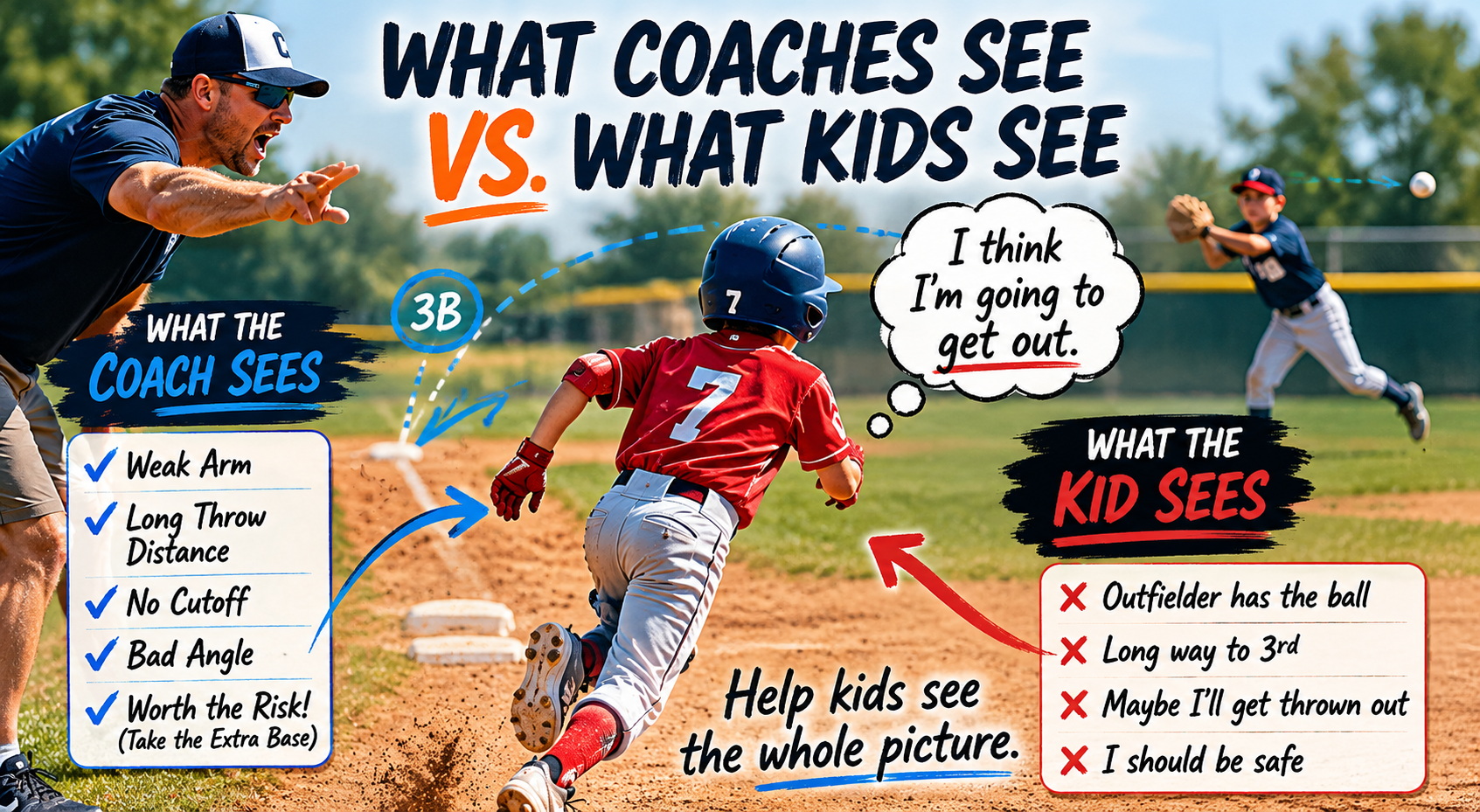
Runner on first. Ball hit hard into right field. I am coaching third base yelling, "Go! Go! Go!"
The runner rounds second, then slams on the brakes and retreats back to the bag because they think they might get thrown out at third.
From the player's perspective, the decision made complete sense. They saw an outfielder with the ball, a long distance to third base, and a possible tag play.
What they did not see was the right fielder had a weak arm, the ball was bobbled, the throw angle was bad, the player took too long getting rid of the ball, and the third baseman was not ready.
As coaches, we calculate all of that instantly. Kids don't yet.
That was the moment I started realizing youth baseball and softball players often are not disobeying coaches. They simply do not yet process the game the same way adults do.
What young players see vs. what coaches see
One of the biggest mistakes coaches make is assuming kids think like miniature adults. They don't.
Most players ages 7-10 are processing the ball, fear of making mistakes, where they are supposed to stand, whether parents are watching, whether they will get yelled at, and whether they are about to get tagged.
Meanwhile, coaches are trying to teach baseball situational awareness, softball situational awareness, force plays, cutoff angles, defensive priorities, aggressive baserunning, and game management.
That is a massive mental gap. The best youth baseball coaching tips and youth softball coaching tips are usually not louder instructions. They are clearer explanations.
Here is the framework I come back to over and over:
Teach the read before correcting the result.
When kids understand what you saw, they start making better decisions the next time.
Situations young players do not instinctively understand
These are the baseball situations for kids I teach again and again in practice. I use the same format every time: the situation, what the kid thinks, what the coach sees, how to explain it, and a simple practice idea.
1. Listening to the base coach before trusting your own fear
- The situation
- A runner is told to take an extra base after a hit, bobble, or bad angle in the outfield.
- What the kid thinks
- "I see the ball. I might get out. I should stop before I make a mistake."
- What the coach sees
- A weak arm, no cutoff, a slow transfer, a bad throwing lane, or a fielder who is not ready for the play.
- What to say
- "You can see one part of the field. Coaches can see the whole picture. If I send you, trust my eyes."
- Practice idea
- Run controlled chaos baserunning. Build in bobbles, slow throws, and overthrows so players feel why extra bases are available.
2. Running hard through first base every time
- The situation
- A batter hits a routine grounder and slows down a few steps before first base.
- What the kid thinks
- "I'm probably already out, so running all the way does not matter."
- What the coach sees
- Throws get dropped, first basemen stretch late, defenders rush, and pressure creates mistakes in youth games.
- What to say
- "Make the defense prove they can get you out."
- Practice idea
- Time home-to-first sprints, then add live throws where first base sometimes drops the ball. Reward full-speed effort, not just safe calls.
3. Not watching the ball while running bases
- The situation
- A runner stares at the ball and stops moving instead of listening to the base coach.
- What the kid thinks
- "I need to see where the ball goes before I know what to do."
- What the coach sees
- Hesitation costs extra bases and turns pressure on the defense into an easy out.
- What to say
- "Your feet should never stop while your eyes are thinking. Find the coach and keep moving."
- Practice idea
- Use a coach at first and third during baserunning reps. Players earn points for finding the coach quickly, even before they know where the ball landed.
4. Rounding the base aggressively
- The situation
- A runner touches first or second and turns straight toward the next base without a good angle, or stops on the bag completely.
- What the kid thinks
- "The base is the safe place. I should get there and wait."
- What the coach sees
- A wide, aggressive turn keeps the runner moving and makes the defense rush the next decision.
- What to say
- "Touch the inside corner, turn like you might keep going, then listen."
- Practice idea
- Set cones for banana turns at first and second. Turn it into a relay where the cleanest angle and loudest coach response wins.
5. Tagging up and freezing until you know
- The situation
- A fly ball is hit with fewer than two outs and a runner leaves too early or drifts too far from the base.
- What the kid thinks
- "There is no way that gets caught. I should run now."
- What the coach sees
- An easy double play if the catch is made, especially when the runner guesses instead of reading.
- What to say
- "Freeze until you know. If it drops, we go. If it is caught, we are safe on the base."
- Practice idea
- Run freeze-or-go fly ball drills. Mix catches, drops, and trapped balls so players learn to wait for information.
6. Running on contact with two outs
- The situation
- There are two outs and the runner waits to see what happens after the ball is hit.
- What the kid thinks
- "I should make sure the ball gets through before I risk running."
- What the coach sees
- With two outs, there is no tag-up decision. The inning ends on the next out, so runners need a full-speed jump.
- What to say
- "Two outs means run on contact. The ball hits the bat, your feet go."
- Practice idea
- Play two-out innings in practice. Every ball in play starts all runners moving immediately, and the team counts runs saved or scored by quick jumps.
7. Keeping going when the ball gets past an outfielder
- The situation
- A ball gets through or past an outfielder and the runner stops at the next base.
- What the kid thinks
- "I made it to the next base, so I did my job."
- What the coach sees
- In youth baseball and softball, one ball past an outfielder can become two bases if the runner reacts right away.
- What to say
- "Ball past them, keep running until a coach stops you."
- Practice idea
- Use outfield gap reps where the runner never stops at the first base they reach unless a coach gives a clear stop sign.
8. Knowing where the play is before the ball is hit
- The situation
- A fielder catches or fields the ball, then looks around trying to decide where to throw.
- What the kid thinks
- "First I field it. Then I will figure out what to do."
- What the coach sees
- By the time the player decides, the easy out may be gone. The play should be known before the pitch.
- What to say
- "Before every pitch, tell yourself: if it comes to me, where am I going?"
- Practice idea
- Ask one player before every pitch in practice, "Where are you going if it comes to you?" Rotate until everyone answers quickly.
9. Taking the easy out instead of the hero play
- The situation
- A young infielder chases a lead runner, spins, or throws across the body instead of taking the simple out.
- What the kid thinks
- "Big plays are exciting. If I get that runner, everyone will be proud."
- What the coach sees
- Youth games are usually won by routine outs, accurate throws, and avoiding extra mistakes.
- What to say
- "Take the easy out first. Boring outs win games."
- Practice idea
- Play an easy-out game. The defense gets two points for the safe, simple out and zero for wild hero throws, even if the idea was exciting.
10. Backing up throws
- The situation
- A player watches a throw because the ball is not supposed to come to them.
- What the kid thinks
- "That play is over there. I am not involved."
- What the coach sees
- Overthrows happen constantly. One backup can save a run, sometimes two.
- What to say
- "Good teammates move before they are needed."
- Practice idea
- Run backup relays. Award the point only if the backup player is already moving before the throw leaves the hand.
11. Covering bases without being told
- The situation
- The ball is hit and nobody covers second, third, or home because every player follows the ball.
- What the kid thinks
- "The ball is not near my base, so I should go toward the ball."
- What the coach sees
- The defense needs a place to throw. Empty bases turn decent fielding into chaos.
- What to say
- "Every throw needs a home. Your job might be to be that home."
- Practice idea
- Run no-bat defensive reads. Roll balls to different spots and freeze the field to check who covered each base.
12. Moving every pitch and getting into ready position
- The situation
- A player stands flat-footed until the ball is already hit.
- What the kid thinks
- "I will move if it comes to me."
- What the coach sees
- Ready position is not decoration. It is the first step of the play.
- What to say
- "Move on every pitch. The game starts before the ball is hit."
- Practice idea
- Use a ready-position freeze game. On the pitch, every fielder has to hop, creep, or reset before the coach can hit or roll the ball.
13. Sprinting after loose balls
- The situation
- A ball gets loose and the nearest player jogs after it while runners keep moving.
- What the kid thinks
- "I missed it, so the play is already bad."
- What the coach sees
- The mistake is not over. The recovery speed may be the difference between one base and three.
- What to say
- "The fastest player after a mistake usually saves the play."
- Practice idea
- Make loose-ball recovery a race. Roll balls past players and time how fast they retrieve, turn, and throw to a target.
14. Putting the ball in play instead of swinging for a home run every time
- The situation
- A hitter takes giant swings every at-bat and misses hittable pitches.
- What the kid thinks
- "The best hit is the biggest hit."
- What the coach sees
- At ages 7-10, balls in play create pressure. Grounders, hard contact, and line drives force youth defenses to make plays.
- What to say
- "Hard contact helps the team. Make them field it."
- Practice idea
- Play contact points in batting practice. A hard ball in play earns more than a giant swing that misses.
15. Shortening the swing with two strikes
- The situation
- A hitter keeps the same big swing with two strikes and strikes out on a pitch they could have fouled off.
- What the kid thinks
- "I always swing the same way. I am trying to hit it hard."
- What the coach sees
- With two strikes, the job changes. The hitter needs to protect, battle, and put pressure back on the pitcher.
- What to say
- "Two strikes means shorter and tougher. Protect the plate."
- Practice idea
- Run two-strike rounds where every hitter starts 0-2 and earns points for fouls, contact, and balls put in play.
16. Understanding that a walk is good
- The situation
- A player walks to first looking disappointed because they did not get to hit.
- What the kid thinks
- "A walk is boring. I did not help."
- What the coach sees
- A walk is a baserunner, a chance to score, and proof the hitter made good decisions.
- What to say
- "A walk is winning the at-bat. You helped the inning keep going."
- Practice idea
- Track team on-base points in scrimmages. Walks, hit-by-pitches, and singles all count as reaching base.
17. Recovering after mistakes
- The situation
- A player makes an error, tears up, and mentally leaves the next play.
- What the kid thinks
- "I ruined the game. Everyone is mad at me."
- What the coach sees
- Baseball and softball are built around failure. The next pitch still needs that player.
- What to say
- "The next play matters more than the last play."
- Practice idea
- Run reset reps. After a miss, the player takes one breath, says the next play out loud, and gets another ball immediately.
18. Communicating loudly
- The situation
- Two fielders drift toward a fly ball silently, or a cutoff player waits without calling for the throw.
- What the kid thinks
- "I know what I am doing, but yelling feels weird."
- What the coach sees
- Quiet defenses collide, hesitate, or throw to the wrong spot. Loud players make the whole team calmer.
- What to say
- "Your voice is part of the play. If you know it, say it loud."
- Practice idea
- Play communication-only fly balls and relays. A technically good play does not count unless the call was loud enough for everyone to hear.
How coaches accidentally create confusion
This was something I had to learn myself over the years. Sometimes coaches overload kids with too much information.
We yell, "Cutoff!" "Force!" "Tag!" "Get two!" "Watch the runner!" "Move up!" "Go back!" all at once.
Meanwhile, the player may still be trying to remember where left field is.
There are four ways we accidentally create confusion when coaching youth baseball or coaching youth softball:
- Yelling too many instructions: A player who hears six commands often executes none of them well.
- Assuming kids know baseball vocabulary: Words like force, cutoff, tag up, relay, and backup sound simple to adults, but they are not automatic for young players.
- Correcting the result without explaining the read: "Why didn't you go?" is less useful than explaining what the coach saw that made going the right choice.
- Giving adult-level explanations to 8-year-olds: A perfect tactical explanation can still fail if the language is too big for the moment.
Simple language creates faster reactions. Instead of "Recognize the defensive alignment and evaluate the cutoff," try "Ball gets past them, keep running." That is language a 7- or 8-year-old can use under pressure.
How I started teaching situations differently
Early on, I coached assuming players understood more than they actually did. Over time, I realized young players need context before correction.
Now, instead of starting with, "Why didn't you run?" I try to ask, "What were you thinking there?"
That question changes everything, because usually the answer makes sense from the child's perspective. They were scared of being tagged. They thought the ball would be caught. They thought the play was over. They did not know where the force was. They saw one piece of the field and made the safest decision they could think of.
Once you understand what the player saw, you can teach more effectively.
I also started using simple repeatable phrases:
- "Make the defense prove it."
- "Freeze until you know."
- "Two outs, run on contact."
- "Take the easy out first."
- "Good teammates move before they are needed."
- "The next play matters more than the last play."
Those phrases are not magic. The repetition is what makes them work. When the same words show up in practice, in games, and in calm post-play teaching moments, kids begin to connect the phrase to the read.
Free situational awareness cheat sheet for coaches
To make this easier to teach at practice, I put together a printable cheat sheet you can use with your team: situation, what the kid thinks, what the coach sees, what to say, and a drill idea.
Cheat sheet preview
This is the same simple teaching pattern I like for youth baseball drills and youth softball drills. Keep the wording short enough that a player can repeat it back to you.
| Situation | What the kid thinks | What the coach sees | What to say | Drill idea |
|---|---|---|---|---|
| Extra base on a hit to the outfield | "I might be out." | Weak throw, bobble, bad angle. | "Trust the coach's whole-field view." | Controlled chaos baserunning. |
| Routine grounder to first | "I'm already out." | Dropped throws happen under pressure. | "Make the defense prove it." | Timed home-to-first races with live throws. |
| Fly ball with fewer than two outs | "It probably drops." | Leaving early creates an easy double play. | "Freeze until you know." | Freeze-or-go fly ball reads. |
| Ball fielded with runners on | "I'll decide after I get it." | The easy out disappears quickly. | "Know the play before the pitch." | Pre-pitch where-are-we-going questions. |
| Overthrow or missed catch | "The mistake already happened." | Recovery speed can save runs. | "Sprint after the loose ball." | Loose-ball recovery races. |
| After an error | "I ruined it." | The next pitch still needs them. | "Next play matters most." | Reset reps after every miss. |
Helping kids understand the why
One of the best things youth baseball and softball coaches can do is explain why situations matter. Not just "because coach said so," but why aggression matters, why communication matters, why positioning matters, and why simple outs help the team.
Kids buy into situations faster when the game begins making sense to them.
And honestly, that is when baseball and softball become way more fun for everyone. Players gain confidence. Coaches get fewer frozen moments. Parents see smarter baseball. Teams become more connected.
Keep building smarter, calmer teams
Coach Joel's Way is built around practical youth baseball and softball coaching tools, including lineup planning, fairness tracking, printable lineup cards, and coaching resources for real rec ball teams.
If you want tools that help you organize lineups and spend more time actually coaching, explore the free web tools or the iPhone and iPad app.
FAQ: coaching youth baseball and softball situations
How do you teach situational awareness in youth baseball?
Teach situational awareness in youth baseball with repetition, simple language, and game-like drills. Ask players what they should do before the ball is hit, explain the read after the play, and use short phrases they can remember under pressure.
Why do youth baseball players freeze during games?
Most young players freeze because they are processing too much at once. They may be watching the ball, worrying about getting out, listening for a coach, and trying not to make a mistake. The fix is not always louder coaching. It is clearer teaching before the moment happens.
What age should kids learn baseball situations?
Players can start learning simple baseball situations around ages 7-10. Keep the lessons small: run through first, listen to the base coach, freeze on fly balls, know the force, and move every pitch. More complex baseball IQ builds from those basics.
How do you improve baseball IQ for kids?
Improve baseball IQ for kids by asking what they saw, teaching the why behind the decision, and turning repeated game moments into mini-games. Teaching baseball IQ works best when players get to practice the same read many times in a low-pressure setting.
Are situational baseball lessons important in softball too?
Absolutely. Situational lessons are just as important in youth softball. Softball situational awareness includes baserunning reads, tags, backing up throws, communication, taking easy outs, and understanding what to do before the ball is hit.
What are good youth baseball drills for teaching game awareness?
Good youth baseball drills for game awareness include controlled chaos baserunning, two-out contact scrimmages, freeze-or-go fly ball drills, easy-out decision games, backup relay races, and pre-pitch "where is the play?" questions. The same ideas work well as youth softball drills too.